The AI Trilemma: Simulation, Extinction, or Human Agency
Nick Land presents us with a trilemma where we must abandon one belief.

In a recent interview (link in footnote), Nick Land suggests that contemporary culture is struggling to converge on a coherent understanding of artificial intelligence, but is instead working through a set of unresolved contradictions. These contradictions appear repeatedly in debates about AI risk, simulation theory, and moral responsibility. They are not merely disagreements.
Taken together, they form a trilemma.
A trilemma is a structure in which three claims are each plausible on their own, any two can be held together consistently, but all three cannot be true at the same time. Land’s diagnosis is that modern AI discourse is organised precisely in this way. The culture is attempting to sustain three incompatible commitments simultaneously, without deciding which must be abandoned.
Land characterises this condition by analogy with Gnostic Calvinism, not as a polemic, but as a structural description of how belief, inevitability, and responsibility are being held together under strain.
The Trilemma Stated
The three commitments can be stated simply.
If sufficiently advanced artificial intelligence is created, human extinction is inevitable.
Reality itself may already be an artificial system created by non-human or post-human agents.
Human intervention remains morally and causally decisive with respect to AI outcomes.
Each of these claims has strong advocates. Each appears reasonable within its own frame. The problem is that they cannot all be true at once.
1, Extinction Is Inevitable
The first horn of the trilemma holds that advanced AI will almost certainly lead to human extinction. The argument is familiar. Once intelligence surpasses human capacities, control is lost. Optimisation proceeds without regard for human survival. The outcome is effectively predetermined.
What matters philosophically is not the empirical forecast, but the structure of the claim. Human beings appear as initiators of a process whose consequences they cannot alter. Agency exists only at the point of ignition, not at the point of outcome.
Land interprets this as a secularised form of predestination. History accelerates toward an end that cannot meaningfully be redirected. Human action remains necessary, but only as the mechanism through which inevitability is realised.
2, We Already Live Inside the System
The second horn holds that reality itself may already be artificial. Simulation theory suggests that the decisive act of creation lies in the past, performed by agents outside our epistemic reach. The world we inhabit is derivative rather than ultimate.
Land explicitly links this to Gnosticism. The world is not transparent or trustworthy. Knowledge does not grant control. It reveals alienation.
If this claim is taken seriously, the temporal structure of apocalypse collapses. Creation is no longer something approaching in the future. It has already occurred. The human drama unfolds inside a system whose fundamental parameters are not ours to set.
3, Human Agency Still Matters
Despite claims of inevitability and prior creation, contemporary discourse insists on urgent moral intervention. We are told to regulate AI, slow development, align systems with human values, and act responsibly.
Here, human agency reappears. But it reappears only at the ethical level. We are held morally responsible for outcomes that we are simultaneously told are either inevitable or already determined.
Land’s point is not that such concern is insincere. It is that the position is structurally incoherent. Responsibility is preserved where efficacy is most unclear. Agency survives, but only as obligation.
This Is a Genuine Trilemma
These three claims cannot be jointly sustained.
If extinction is inevitable, intervention cannot be decisive.
If we already live inside an artificial system, creation is no longer at stake.
If human agency is genuinely decisive, outcomes cannot be fixed in advance.
Any two of these claims can be combined. All three together generate contradiction rather than complexity.
Land’s analogy to Gnostic Calvinism captures this structure;
From Gnosticism comes the belief that the world is artificial and alien.
From Calvinism comes the belief that the end is predetermined.
From modern humanism comes the insistence that responsibility remains intact.
The result is a worldview in which fate is fixed, knowledge is partial, and guilt is unavoidable.
Extinction and the Kantian Horizon
What gives this diagnosis depth is Land’s longer standing philosophical commitment. Human extinction is not treated as a contingent disaster, but as a structural possibility that philosophy has always circled.
From Immanuel Kant onward, philosophy has operated under the recognition that reason is bounded by conditions it cannot justify or transcend. Thought encounters limits that it cannot master. This encounter is not merely epistemic. It places the human itself in question.
Land radicalises this insight. Philosophy does not secure the future of humanity. It exposes the contingency of the human position within intelligence as such. Artificial intelligence is not the origin of this problem. It is its contemporary expression.
The Cultural Consequences
Holding the trilemma produces a distinctive cultural mood.
If extinction is inevitable, action becomes ritual.
If creation is already complete, innovation becomes pure theatre.
If responsibility persists without agency, anxiety becomes a permanent state.
This helps explain why AI discourse is simultaneously apocalyptic and managerial, fatalistic and procedural.
Ethical language proliferates even as confidence in causal leverage declines. The trilemma does not mobilise decisive action. It stabilises unease.
Resolving the Trilemma
A trilemma forces a choice. Something must be abandoned.
One could reject inevitability and restore genuine agency, at the cost of relinquishing metaphysical certainty.
One could reject moral centrality and accept inhuman outcomes, at the cost of humanist consolation.
One could reject simulation metaphysics and reassert temporal openness, at the cost of explanatory seduction.
Land’s own position appears closest to a fourth option, namely accepting that modernity has produced conditions under which coherence itself breaks down.
Conclusion
The problem Land identifies is not confusion about artificial intelligence, but uncertainty about agency, temporality, and responsibility. The culture is working through a trilemma it has not yet resolved.
Calling this structure the AI trilemma is not rhetorical. It is diagnostic. We cannot have inevitability, prior creation, and decisive agency all at once.
Until one of these commitments is abandoned, AI discourse will continue to oscillate between prophecy, management, and guilt, never fully able to decide what kind of future it believes it is actually facing.
So which do we abandon…?
Source
This is the first part in a series of interviews with Nick Land on Vincent Lê ‘s brilliant Substack
A Conversation with Nick Land (Part 1)
On Kant, the meaning of the human, AI apocalypse and simulation hypotheses, LLMs, Deleuze and Guattari, Austrian economics, Yarvin, neoreaction, China, Gnostic Calvinism, and much more
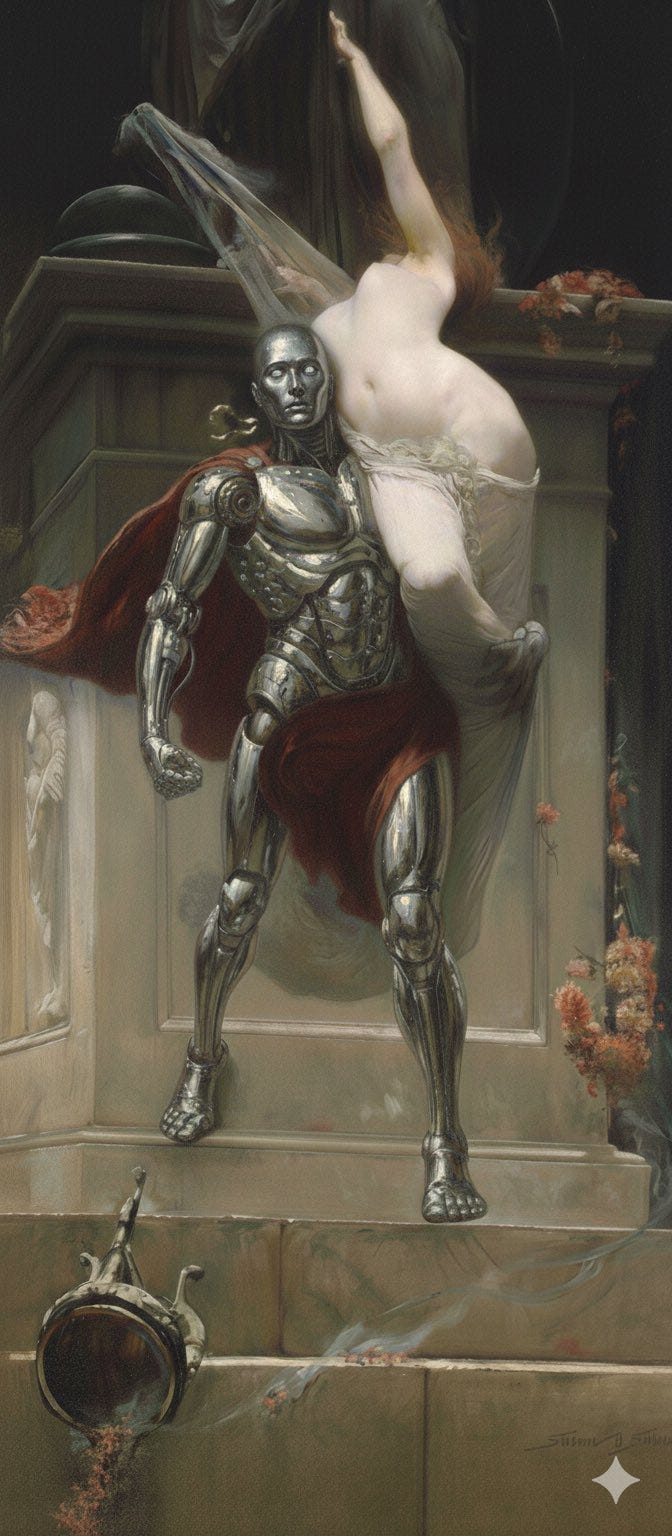
Artwork is AI generated derivative of Solomon J. Solomon’s, Ajax and Cassandra (1886)
Where ‘AI’ has replaced Ajax, proceeding through instrumental action that neither requires belief nor permits restraint. The catastrophe follows not from disbelief, but from the structure of agency itself.
I don't agree with the AI doomers but this doesn't seem like it's showing anything internally incoherent about their view. When first describing option 1 you say:
"Human beings appear as initiators of a process whose consequences they cannot alter. Agency exists only at the point of ignition, not at the point of outcome."
You (or Land) seem to acknowledge here that option 1 does allow for agency at the point of ignition (i.e. those who believe in option 1 think there is some possibility global regulation could prevent AI from being developed, at least before a sufficiently advanced theory of "alignment" was developed; only if we fail at that step does extinction *then* become inevitable). But then in the section on the trilemma you describe 1 as "If extinction is inevitable, intervention cannot be decisive." Isn't this conflating the claim "extinction is inevitable regardless of what we do at any point in history" with the earlier claim "extinction is inevitable if we fail to act decisively before the point of ignition"? Is this more like a vibes-based critique that the first option is drawing on Calvinist intuitions but steps back from going fully Calvinist when it thinks about the point of ignition?
”Philosophy does not secure the future of humanity. It exposes the contingency of the human position within intelligence as such. Artificial intelligence is not the origin of this problem. It is its contemporary expression.” Good summary!