There are no credibly neutral protocols in crypto. So pick a politics, to pick a market 🏴☠️

As I’ve covered in previous articles The Westphalian order is failing visibly, on every front, all at once. The universalist post Cold War assumption — that a set of global protocols could rise above sovereigns and let individuals and companies freely transact, communicate and coordinate without permission — is being abandoned. Every advanced economy is now openly pursuing national sovereignty across the stack: financial, cognitive, manufacturing, biological, associative. The rungs of the Sovereignty Ladder I sketched in the last piece, is what every serious state is already climbing.
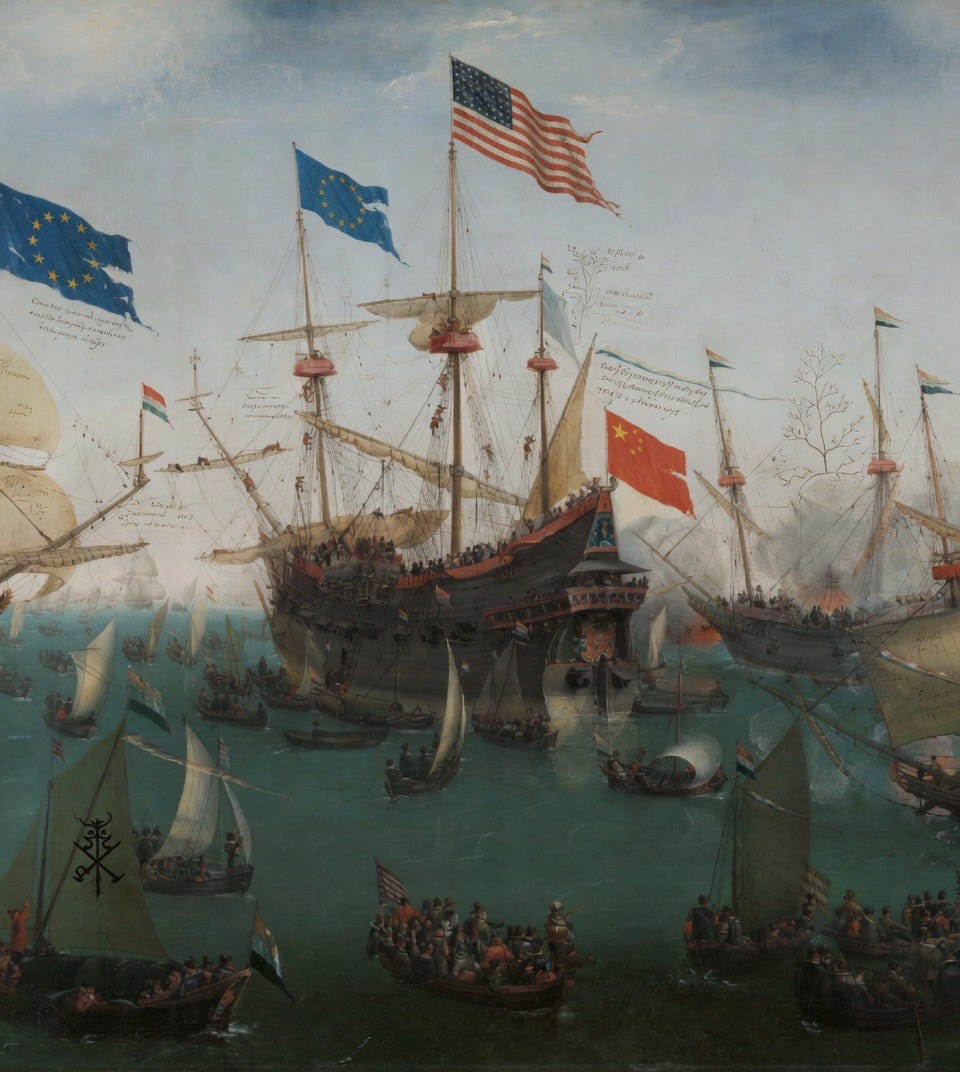
Crypto in the cypherpunk tradition told us cryptography could give us individuals — sovereignty over money, identity, communication, coordination (and critically) exit. For thirty years that story produced extraordinary work. Bitcoin, the most consequential monetary innovation since the gold standard collapsed. And an adjacent stack of protocols that work, daily, at scale, without permission.
But this new emerging context requires we are honest about what has happened to that work. Crypto’s most successful protocols have largely been captured into one orbit. The American one. Dollar stablecoins are dollars. ETF wrappers route Bitcoin through US securities law. The largest validator sets cluster in US-aligned jurisdictions. The frontier of token issuance defers to the SEC. The GENIUS Act didn’t capture the industry — it ratified a capture that had already happened, by acknowledging that the most economically meaningful crypto rails are now extensions of US monetary and regulatory sovereignty.
Which leaves us with a choice we have perhaps been putting off. We can accept that orbit and serve it, openly, as the industry’s actual political home. Or we can distribute our efforts towards realising different politics — plural, explicit, defended — across the rungs of the ladder. What we cannot do any longer is pretend we are building a credibly neutral global stack above sovereigns. That stack has visibly become one sovereign’s stack, with everyone else permitted to use it.
This is what the emergent neo-cypherpunk has to reckon with. What the term means is still being written — by readers and writers I read alongside, by the falsification of frames I have been working through publicly, by the next decade of contested rungs. But this much is the foundation: cryptography can build credibly neutral communication protocols. It cannot build credibly neutral economic protocols. The moment you imbue a communication protocol with economics, you directly incentivise a politics — not as a corruption of the design, but as a function of it.
A communication protocol routes. TCP/IP doesn’t care whose packet, what packet, to whose benefit. SMTP doesn’t care whose email. HTTP doesn’t care whose request. There is no validator who gets paid more if your packet arrives. There is no token that appreciates when traffic flows. Nobody inside the protocol has a position on what the protocol does.
That is what neutrality looks like, in the strict sense. It is a structural property of having no allocative function.
An economic protocol allocates. Allocation requires a rule. A rule has beneficiaries. Beneficiaries become stakeholders. Stakeholders, given time and stakes, organise. Organised stakeholders lobby, coordinate, capture and politicise — not eventually, not as a failure mode, but on a thermodynamic schedule. The only variable is speed.
You cannot escape this with mechanism design. Vitalik’s canonical four conditions for credibly neutral protocols — don’t write specific people or outcomes into the mechanism, be open-source and verifiable, be simple, don’t change too often — are real and necessary. They are also insufficient. They define neutrality in the design of a protocol. They cannot prevent politicisation in the operation of one, once stakeholders exist and value flows. Mechanism cannot constrain incentive.
This isn’t a critique of the framing. It is the next move after it.
Bitcoin politicised slowest because its rent is diffuse and hard to capture. Mining concentrates, but no single party controls the chain. Custody concentrates, but exit is always available. Even so: the block-size war was politics. ETF wrappers are politics. Strategic reserves are politics. Saylor is politics. Bitcoin’s neutrality is a property of its base layer that erodes with every layer above it. Pure at the core, captured everywhere it touches the world.
Ethereum politicised faster because Proof-of-Stake embedded validator stakeholder dynamics from genesis. The Merge was politics. EIP-1559 was politics. The Lido concentration is politics. Every governance proposal is a politics-choice dressed as a protocol-choice.
But stablecoins by far politicised fastest because they were never anything but politics in cryptographic clothing. A dollar is a sovereign claim. Tokenising it doesn’t escape the claim — it routes the claim through a wrapper that is more legible to enforcement, not less.
The variable that determines speed is how much rent the protocol generates and how legible that rent is to existing power. Bitcoin’s rent is diffuse and politically illegible. Stablecoin rent is concentrated and trivially legible. The faster the rent, the faster the politicisation. There are no exceptions.
And then there are agents — the most dangerous protocol class, because here the politicisation isn’t merely fast. It’s invisible.
When you imbue a comms protocol with economics, you directly incentivise a politics. When you imbue an agent with economic agency, you delegate your politics — to whoever trained the agent, designed its defaults, chose its tool registry, optimised its commercial incentives. The agent transacts on your behalf, settles on rails of its choosing, picks counterparties you will never see, allocates capital you stop tracking. Every one of those is a politics-choice. None of them is yours.
Crypto’s politicisation was at least visible at the protocol layer. You could read the validator set, audit the contract, watch the governance vote, see the capture happen. Agentic politicisation is invisible by design. The capture happens upstream — in the model weights, the alignment training, the protocol defaults, the commercial relationships of whoever ships the agent. By the time the agent is acting on your behalf, the politics has already been picked. You are just executing it.
This is the cognitive rung of the Sovereignty Ladder doing its work in real time. And it makes the question of which politics our protocols incentivise more urgent, not less. Delegating economic agency to an agent without naming whose politics that agent serves is how plural sovereignty gets quietly resolved into one — at the speed of execution, at machine scale, in defence of a stack you never agreed to climb.
Which means the honest design question — the only honest design question, once you have accepted the mechanism — is no longer how do we build neutral? It is which politics am I incentivising, and is it the one I want?
This is the question we all need to make as builders, investors or participants in a given network. Andreessen and A16z, Thiel and Founders Fund, have explicitly backed American Accelerationism and who can blame them.
The cypherpunk question was: how do we build protocols that escape politics?
The neo-cypherpunk question is: which politics do we want our protocols to incentivise?
We avoided the second question for decades by naively insisting the answer to the first was “we already did, through cryptography.” The answer was never that. The answer was always libertarian-American-capital politics, encoded in mechanism, reproduced through token distribution, captured eventually by whoever could organise stakeholders fastest. That is a politics. It is a specific one. It has specific beneficiaries and specific enemies. Pretending it was the absence of politics was the move that made the capture inevitable, because you cannot defend a politics you refuse to name.
So name it. Pick one. Defend it.
What survives this reframe?
Well cryptographic primitives survive. Hashes, signatures, zero-knowledge proofs, encryption. They are mathematics. They have no stakeholders.
Communication-layer protocols survive. The parts of the stack that route without allocating.
Settlement, narrowly, survives — when the settlement layer extracts no rent and embeds no governance.
And bridges survive. This is where the surviving idea lives: credibly neutral as a property of interoperability infrastructure between sovereign stacks, not as a substitute for them. Bridges between Chinese cosmotechnical AI and American agent stacks. Bridges between EU sovereign cloud and crypto-native settlement. Bridges between civilisational tech-stacks that have stopped pretending they share values. Bridges require minimum viable trust surface, no privileged validator, exit guarantees, settlement finality independent of any single jurisdiction. That is a real engineering property. It is worth fighting for. It is just not the same fight as building constitutive layers.
Everywhere a protocol does constitutive work — money issuance, identity, governance, dispute resolution, AI alignment, manufacturing standards, biological data, associative membership — you cannot escape choosing a politics. The honest move is to choose openly, defend it, and federate with others through bridges. The dishonest move to yourself is to pretend you have transcended politics through cryptography.
The first preserves what cypherpunk actually achieved. The second is what got us captured.
Each rung of the Sovereignty Ladder is an economic-protocol contest. Cognitive sovereignty isn’t a comms-layer fight — it is an allocation fight. Who trains. Who serves. Who pays whom for what cognition. Manufacturing sovereignty is allocation. Biological is allocation. Associative is allocation-of-membership. None of these can be credibly neutralised, because none of them are pure communication. All of them require a politics.
The states are climbing the ladder explicitly. The US is picking a politics. China is picking a politics. The EU is picking a politics. Individuals are climbing it with whatever tools they can claim — and the tools are increasingly stacks owned by states, or by the platforms states regulate. The Westphalian collapse isn’t producing a neutral global protocol layer. It is producing plural sovereign stacks contesting each rung, and the only viable cypherpunk inheritance in that world is bridges between them, with exit always available.
Cis-Lunar could be plural or a Musk techno-monarchy. There is no third option that runs on credibly neutral protocols, because Cis-Lunar is allocation all the way down. Pick a politics now and federate, or pick a sovereign later and submit.
And let’s be honest about what that choice actually is. Picking a politics as a builder or investor is picking a market. This is not only an ideological move — it is a commercial one. Every sovereign stack is also a market. Every politics is also a portfolio decision. The capital that flows through American agent stacks is not the capital that flows through Chinese cosmotechnical ones. The rails that settle dollar liquidity are not the rails that will settle plural sovereign liquidity. The founders who build for the orbit crypto has been captured into are not the founders who build for the rungs that orbit doesn’t yet own. There is no commercially neutral position, any more than there is an ideologically neutral one. Every fund, every founder, every protocol is already implicitly picking. The only question is whether they are doing it consciously, and whether their thesis admits it.
The cypherpunk values that survive are the load-bearing ones. Exit. Privacy. Cryptographic verification. The right to defect from a stack whose politics you reject.
The value that retires is universalist neutrality as the goal. It was never the goal. It was the legitimation fiction that let an industry avoid the question of what politics it was actually building. The fiction has done its work. It is now load-bearing for capture, not for liberation.
Cryptography gave us the ability to exit. It never gave us the ability to transcend politics. The first is enough — if we stop confusing it for the second.
Pick a politics. Pick a market. And serve them.
Is it possible that Ethereum means more than just American politics?